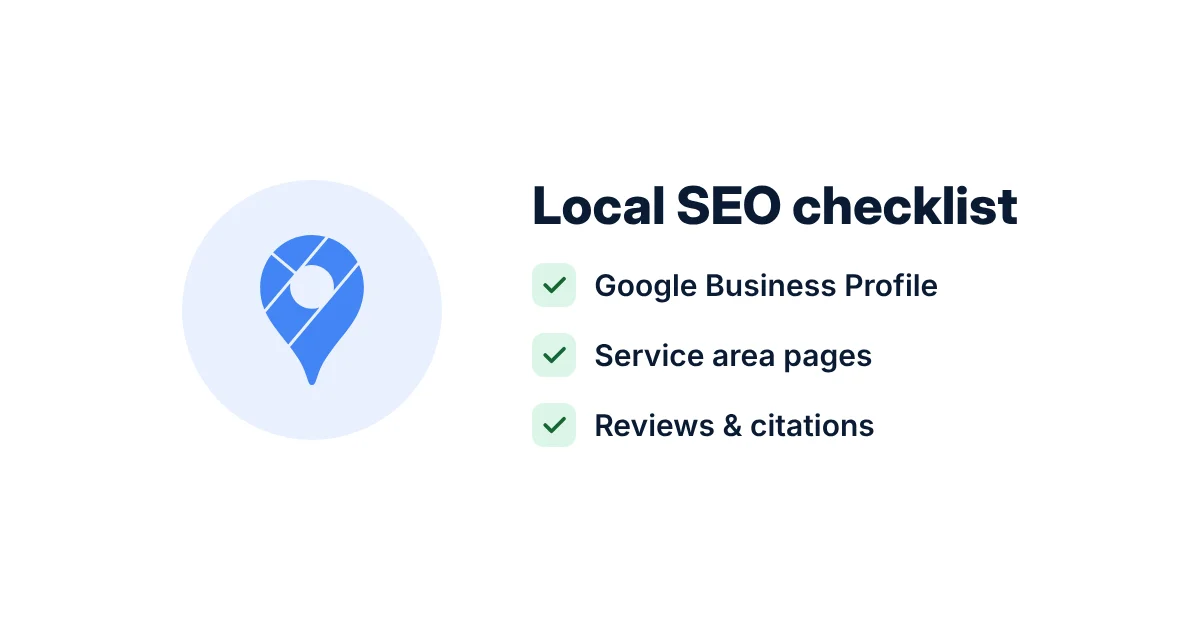
Local SEO helps nearby customers discover, evaluate and contact a service business. Strong local visibility comes from consistent business information, useful location-focused pages, a complete business profile, trustworthy reviews and a website that makes the next step obvious.
Confirm your business information
Use one accurate business name, address, phone number, hours and primary website URL wherever the company appears. Resolve duplicates and document how service-area locations should be represented. For local service businesses that depend on calls, bookings and quote requests, this decision should connect directly to a repeatable local search program that improves qualified visibility and tracks real leads. That keeps the discussion grounded in business value instead of surface-level features or assumptions.
Optimize the Google Business Profile
Select the most accurate categories, describe services clearly, upload authentic photos, maintain hours and use profile features that help customers understand and contact the business. For local service businesses that depend on calls, bookings and quote requests, this decision should connect directly to a repeatable local search program that improves qualified visibility and tracks real leads. That keeps the discussion grounded in business value instead of surface-level features or assumptions.
Build strong service pages
Give each important service a focused page that explains the problem, process, proof, service area and next action. Avoid thin pages that merely swap city names. For local service businesses that depend on calls, bookings and quote requests, this decision should connect directly to a repeatable local search program that improves qualified visibility and tracks real leads. That keeps the discussion grounded in business value instead of surface-level features or assumptions.
Create useful location content
Location pages should reflect real local knowledge, availability, regulations, neighborhoods, travel areas and customer questions. Unique value is more useful than mass-produced geographic pages. For local service businesses that depend on calls, bookings and quote requests, this decision should connect directly to a repeatable local search program that improves qualified visibility and tracks real leads. That keeps the discussion grounded in business value instead of surface-level features or assumptions.
Earn and manage reviews
Ask customers at appropriate moments, make the process easy and respond professionally. Review programs should be consistent, ethical and connected to service recovery. For local service businesses that depend on calls, bookings and quote requests, this decision should connect directly to a repeatable local search program that improves qualified visibility and tracks real leads. That keeps the discussion grounded in business value instead of surface-level features or assumptions.
Improve on-page and technical SEO
Use descriptive titles, headings, internal links, crawlable navigation, fast mobile layouts, accessible content and appropriate LocalBusiness structured data. For local service businesses that depend on calls, bookings and quote requests, this decision should connect directly to a repeatable local search program that improves qualified visibility and tracks real leads. That keeps the discussion grounded in business value instead of surface-level features or assumptions.
Build citations and local authority
Maintain accurate profiles on relevant directories, associations and industry sites. Local partnerships, sponsorships and useful resources can earn stronger mentions than generic directory submissions. For local service businesses that depend on calls, bookings and quote requests, this decision should connect directly to a repeatable local search program that improves qualified visibility and tracks real leads. That keeps the discussion grounded in business value instead of surface-level features or assumptions.
Measure calls, forms and bookings
Track organic landing pages, profile interactions, qualified calls, form submissions, booked appointments and revenue. Rankings alone do not show whether local SEO is producing customers. For local service businesses that depend on calls, bookings and quote requests, this decision should connect directly to a repeatable local search program that improves qualified visibility and tracks real leads. That keeps the discussion grounded in business value instead of surface-level features or assumptions.
Build a 30-day implementation plan
Turn the guide into action by choosing one owner, one baseline metric and one outcome for the next 30 days. During week one, document the current state and remove obvious errors. During week two, implement the smallest high-value improvement. During week three, observe real use and collect questions. During week four, compare the new result with the baseline and decide what to standardize, revise or stop.
Keep the plan intentionally narrow. Teams make more progress when they complete one measurable cycle than when they open ten initiatives at once. Store decisions, credentials, content and process notes in systems the team controls. When outside specialists are involved, confirm ownership, access and handoff requirements before work begins.
If you want help translating this plan into a working system, explore DigiDesk’s SEO services or book a strategy call.
Frequently asked questions
How long does local SEO take?
Meaningful improvement often takes months because listings, content, reviews and authority develop over time. Competitive markets generally require sustained work.
Do service-area businesses need an address on the website?
They need accurate contact and service-area information, but how an address is displayed depends on the business model and platform policies.
Does LocalBusiness schema improve rankings?
Structured data helps search engines understand business details and may support richer presentation, but it is not a guarantee of higher rankings.
How often should the checklist be reviewed?
Review core data quarterly and after any change to hours, services, phone numbers, locations or website URLs.
Sources and further reading
Next steps
A repeatable local search program that improves qualified visibility and tracks real leads starts with a clear baseline and a focused first improvement. Review the checklist, select the action closest to revenue or customer experience and assign it to one owner. Measure what changes, document what the team learns and use that evidence to decide the next investment.