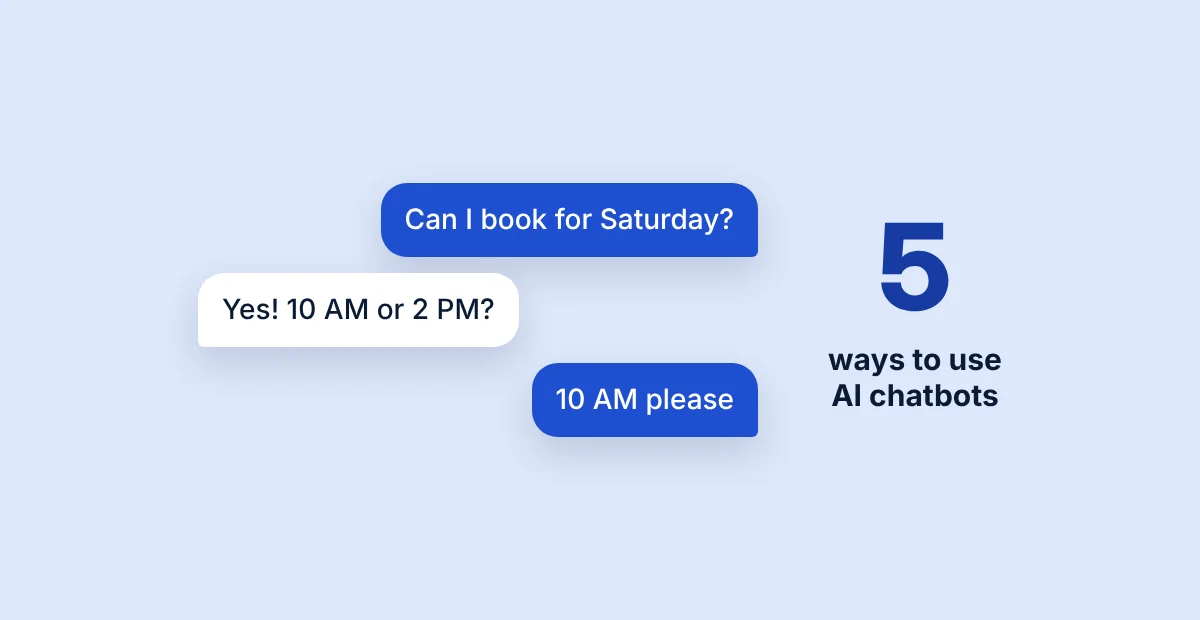
An AI chatbot is most valuable when it handles a narrow, repeatable job with clear boundaries. Small businesses can use chatbots to answer common questions, capture lead details, support scheduling, route requests and help staff find information—while keeping humans responsible for sensitive or unusual situations.
Use case 1: answer common questions
A chatbot can provide approved information about hours, service areas, preparation, policies and next steps. The knowledge source should be maintained and uncertain answers should escalate. For small businesses evaluating practical AI assistants, this decision should connect directly to a focused chatbot use case with guardrails, escalation and measurable business value. That keeps the discussion grounded in business value instead of surface-level features or assumptions.
Use case 2: capture and qualify leads
Collect contact details, service need, location, timing and consent in a conversational flow. Avoid asking for unnecessary sensitive information and send structured data to the correct system. For small businesses evaluating practical AI assistants, this decision should connect directly to a focused chatbot use case with guardrails, escalation and measurable business value. That keeps the discussion grounded in business value instead of surface-level features or assumptions.
Use case 3: support appointment booking
A chatbot can explain availability and connect to an approved scheduling flow. Confirmation, time zone, rescheduling and cancellation rules must be explicit. For small businesses evaluating practical AI assistants, this decision should connect directly to a focused chatbot use case with guardrails, escalation and measurable business value. That keeps the discussion grounded in business value instead of surface-level features or assumptions.
Use case 4: triage customer support
Classify requests, surface help content and route urgent or account-specific issues to people. Customers should always know when they are speaking with automation. For small businesses evaluating practical AI assistants, this decision should connect directly to a focused chatbot use case with guardrails, escalation and measurable business value. That keeps the discussion grounded in business value instead of surface-level features or assumptions.
Use case 5: assist internal teams
Staff can use an internal assistant to search procedures, draft responses and summarize approved knowledge. Access controls should prevent exposure of confidential material. For small businesses evaluating practical AI assistants, this decision should connect directly to a focused chatbot use case with guardrails, escalation and measurable business value. That keeps the discussion grounded in business value instead of surface-level features or assumptions.
Design the knowledge base
Use current, authoritative source documents with clear ownership and review dates. Remove conflicting instructions and structure information around real customer questions. For small businesses evaluating practical AI assistants, this decision should connect directly to a focused chatbot use case with guardrails, escalation and measurable business value. That keeps the discussion grounded in business value instead of surface-level features or assumptions.
Add safety and human escalation
Define prohibited topics, confidence thresholds, emergency language, privacy rules and escalation paths. Review transcripts to identify gaps and unintended behavior. For small businesses evaluating practical AI assistants, this decision should connect directly to a focused chatbot use case with guardrails, escalation and measurable business value. That keeps the discussion grounded in business value instead of surface-level features or assumptions.
Measure chatbot performance
Track resolved intents, qualified leads, bookings, escalation, abandonment, response quality and customer feedback. Optimize for completed outcomes rather than conversation volume. For small businesses evaluating practical AI assistants, this decision should connect directly to a focused chatbot use case with guardrails, escalation and measurable business value. That keeps the discussion grounded in business value instead of surface-level features or assumptions.
Build a 30-day implementation plan
Turn the guide into action by choosing one owner, one baseline metric and one outcome for the next 30 days. During week one, document the current state and remove obvious errors. During week two, implement the smallest high-value improvement. During week three, observe real use and collect questions. During week four, compare the new result with the baseline and decide what to standardize, revise or stop.
Keep the plan intentionally narrow. Teams make more progress when they complete one measurable cycle than when they open ten initiatives at once. Store decisions, credentials, content and process notes in systems the team controls. When outside specialists are involved, confirm ownership, access and handoff requirements before work begins.
If you want help translating this plan into a working system, explore DigiDesk’s AI solutions or book a strategy call.
Frequently asked questions
Will an AI chatbot replace customer service staff?
Usually it works best as a first-line assistant for repetitive requests while people handle judgment, empathy and exceptions.
What information should a chatbot avoid collecting?
Avoid unnecessary sensitive personal, financial, health or authentication information unless the system and process are specifically designed for it.
How accurate are AI chatbots?
Accuracy depends on the model, instructions, knowledge, integrations and controls. Monitoring and escalation remain necessary.
Where should a small business start?
Choose one high-volume, low-risk intent and measure it before expanding.
Sources and further reading
Next steps
A focused chatbot use case with guardrails, escalation and measurable business value starts with a clear baseline and a focused first improvement. Review the checklist, select the action closest to revenue or customer experience and assign it to one owner. Measure what changes, document what the team learns and use that evidence to decide the next investment.