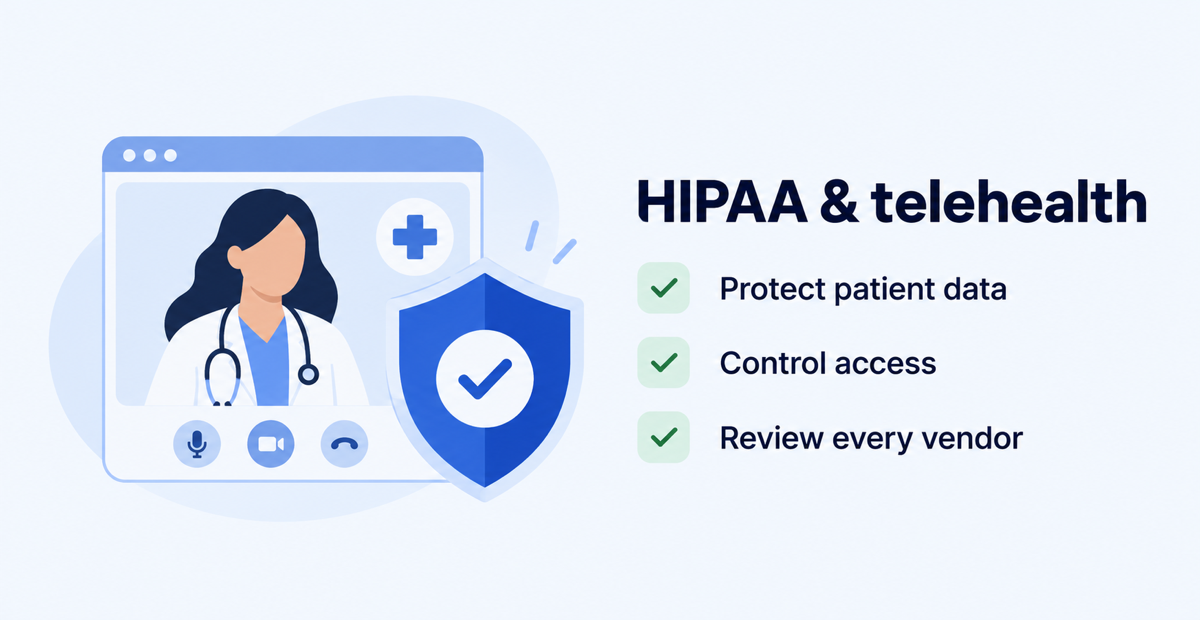
Telehealth platforms can handle appointment details, symptoms, diagnoses, prescriptions, insurance information, video sessions and private messages. When this information is protected health information, privacy and security cannot be treated as features to add after launch.
HIPAA gives regulated healthcare organizations a framework for deciding how health information may be used, disclosed and safeguarded. It also affects how they select vendors, configure software, train staff and respond when information may have been exposed.
Important legal note
This article provides general educational information, not legal advice. HIPAA obligations depend on the organization, data, relationships and use case. Involve qualified privacy, security and legal professionals when assessing a real system.
What is HIPAA?
HIPAA stands for the Health Insurance Portability and Accountability Act of 1996. Among its purposes, the law and its implementing rules establish national requirements for protecting certain health information. HIPAA does not cover every organization that handles health-related information.
The U.S. Department of Health and Human Services provides an official overview of covered entities and business associates.
Protected health information and ePHI
Protected health information (PHI) is individually identifiable health information protected by HIPAA when a covered entity or business associate creates, receives, maintains or transmits it. PHI may be electronic, paper or oral. Electronic PHI, commonly called ePHI, includes information stored or transmitted digitally.
The HIPAA rules most relevant to telehealth
- Privacy Rule: establishes standards for permitted uses and disclosures of PHI and gives individuals rights over their information.
- Security Rule: requires administrative, physical and technical safeguards for ePHI.
- Breach Notification Rule: establishes notification requirements after certain breaches of unsecured PHI.
HHS explains the Security Rule safeguards in its official Security Rule summary.
Who must comply with HIPAA?
HIPAA applies to covered entities—health plans, healthcare clearinghouses and healthcare providers that conduct certain standard electronic transactions—and to business associates that perform covered functions or services involving PHI on their behalf. Some subcontractors are also business associates.
A direct-to-consumer wellness app, informational healthcare website or fitness platform may fall outside HIPAA depending on how it operates and with whom it works. Other health-data, privacy, breach-notification and consumer-protection laws may still apply.
Why the business associate agreement matters
A healthcare provider should not assume a tool is suitable for PHI because it uses encryption or promotes a healthcare plan. When a vendor is a business associate, the parties generally need a business associate agreement (BAA) that defines permitted uses, required safeguards and incident responsibilities. Review the HHS business associate guidance for the official requirements.
Why HIPAA is important for telehealth
Telehealth expands care beyond a clinic, but it also expands the systems, networks, devices and vendors involved in a patient interaction. Information may move through scheduling forms, patient portals, video platforms, messaging services, electronic health records, billing tools and automated reminders.
HIPAA supports patient trust
Patients need confidence that a private consultation will remain private. Clear access controls, secure communication and sensible data practices help support that trust while reducing unnecessary exposure.
HIPAA creates operational accountability
Compliance requires more than choosing software with the right marketing language. Organizations need documented responsibilities, risk analysis, workforce training, incident procedures and vendor oversight. The official HHS telehealth technology guidance is a useful starting point when evaluating remote communication products.
Safeguards for telehealth websites and software
A HIPAA-aware technical review should connect each safeguard to a realistic risk, responsible owner and verification method. The exact controls depend on the system and risk analysis, but the following areas regularly matter.
Identity and access management
Use unique accounts, appropriate authentication, role-based permissions and prompt access removal. Give staff and vendors only the access required for their work, and periodically review active users.
Encryption and secure transmission
Protect ePHI in transit and at rest using methods appropriate to the risk. Confirm where encryption begins and ends, how keys are managed and whether backups and exported files receive equivalent protection.
Audit logs and monitoring
Record meaningful access and administrative activity so an organization can investigate unusual behavior. Logs should be protected, retained according to policy and reviewed through a defined process—not collected and forgotten.
Data minimization and retention
Collect only information needed for the intended service. Define where it is stored, how long it is retained, which integrations receive it and how it is securely removed when no longer required.
Availability, backups and recovery
Patient care can depend on system availability. Test backups, restoration, downtime procedures and communication plans before an emergency. A backup is not a recovery plan until it has been successfully restored.
DigiDesk’s web development service and business automation service can help teams document data flows and technical requirements before implementation. Legal and compliance approval should remain with qualified healthcare advisers.
HIPAA risks specific to healthcare websites
A public marketing page may not contain PHI, but appointment forms, portal sign-ins, symptom checkers and authenticated patient areas can create very different data flows. The page URL, form fields, analytics events or support chat may reveal information about an individual’s care.
Forms and appointment requests
Map every field and destination before launch. Determine whether submissions enter email, a CRM, a scheduling platform or another service, and confirm that each system and relationship is appropriate for the data.
Analytics, advertising and session tools
Third-party scripts can receive page paths, identifiers and interaction details. Inventory scripts page by page, configure them deliberately and obtain case-specific advice. HHS maintains guidance on online tracking technologies, including an important notice about a federal court decision.
Patient portals and integrations
Test authorization, session handling, file access, error messages and API permissions. Verify that one patient cannot access another patient’s information and that failed integrations do not expose sensitive payloads in logs or alerts.
Our healthcare industry page outlines additional website, SEO and workflow considerations for healthcare organizations.
Telehealth vendor and website checklist
Questions to answer before launch
- Which data elements are collected, and which may be PHI?
- Is each organization a covered entity, business associate or another type of party?
- Which vendors and subcontractors can receive or access the data?
- Are required BAAs signed before PHI is shared?
- Has the organization completed and documented a risk analysis?
- Are access, encryption, logging, backup and incident controls configured and tested?
- Are tracking scripts, chat tools and form destinations reviewed?
- Do staff know how to report a suspected privacy or security incident?
- Is there a documented manual process if a system becomes unavailable?
Treat this list as a starting point, not a compliance certification. A qualified review must consider the complete environment, including people, policies, contracts, devices, facilities and data flows.
Build privacy and security into the project
Begin by identifying the people, systems and vendors involved in a patient interaction. Map what information moves between them, remove unnecessary collection and assign an owner to every safeguard and exception path.
If your team is planning a healthcare website or integration, book a strategy call with DigiDesk to discuss the technical scope. Compliance and legal decisions should be confirmed with your organization’s qualified advisers.
Frequently asked questions
What is HIPAA in simple terms?
HIPAA is a U.S. federal law whose rules require covered entities and business associates to protect certain health information and provide individuals with rights over that information.
Does HIPAA apply to every telehealth website or health app?
No. HIPAA applies to covered entities and their business associates. Other federal or state privacy and consumer-protection laws may apply when HIPAA does not.
What makes telehealth software HIPAA compliant?
Compliance depends on contracts, risk analysis, policies, workforce practices, configuration and administrative, physical and technical safeguards. A product label or feature list alone does not establish compliance.
What is a business associate agreement?
A business associate agreement, or BAA, is a written contract that defines how a business associate may use and disclose PHI and how it must safeguard that information.