The honest answer is that a virtual assistant can cost anywhere from about $10 to more than $35 an hour. The hourly rate is only half the picture. What really decides your monthly cost is how many hours you need and how you choose to hire.
Most small business owners start by asking about price, then find that quotes are hard to compare. One provider charges by the hour, another sells a monthly plan and a third offers a full-time assistant by the week.
This guide uses published rates so you can compare them on the same basis. We show where each number comes from, because much of the pricing information online is written by companies selling virtual assistants, including us.
Quick answer: Upwork reports median rates of $10 to $20 an hour, and an average of $18 to $35 an hour depending on skills and experience. For 40 hours a month, a realistic budget is roughly $600 to $1,400.
What a virtual assistant costs by hiring route
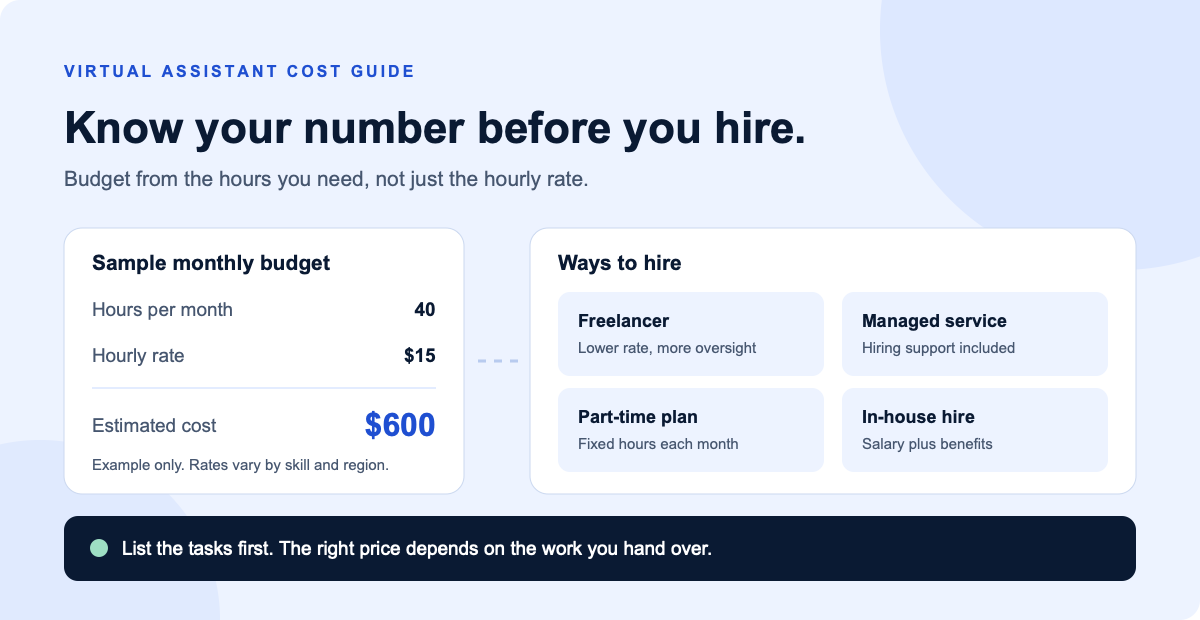
The way you hire changes both the price and how much work falls on you. Here are published figures, plus an in-house comparison:
| Route | Published price | What you are paying for |
|---|---|---|
| Freelance marketplace | $10 to $20 per hour median on Upwork. Upwork also reports an average of $18 to $35 per hour, depending on skills and experience. | The assistant's time. You screen, train and manage them yourself. |
| Managed full-time assistant | $360 per week for 40 hours at Magic, or about $9 per hour, on its standard four-week billing. Its executive assistant plan is $540 per week, or about $13.50 per hour. | A dedicated assistant, with the company handling sourcing. |
| US-based managed assistant | From $1,599 per month at Wing, for an entry-level US assistant. | A US-based assistant through a managed service. |
| In-house employee | $23.23 per hour median pay for US secretaries and administrative assistants, before benefits. | A dedicated employee, plus the costs of being an employer. |
Prices were checked in October 2026 and can change, so confirm them with each provider. These are examples of published pricing, not recommendations. Some providers do not publish prices at all, and you will need a quote from them.
What it costs per month
Monthly cost is simple math: hours multiplied by rate. This table shows example budgets at three common hourly rates:
| Hours per month | Typical use | At $15/hour | At $25/hour | At $35/hour |
|---|---|---|---|---|
| 20 hours | Inbox and calendar help | $300 | $500 | $700 |
| 40 hours | Regular admin support | $600 | $1,000 | $1,400 |
| 80 hours | Part-time role | $1,200 | $2,000 | $2,800 |
| 160 hours | Close to full-time | $2,400 | $4,000 | $5,600 |
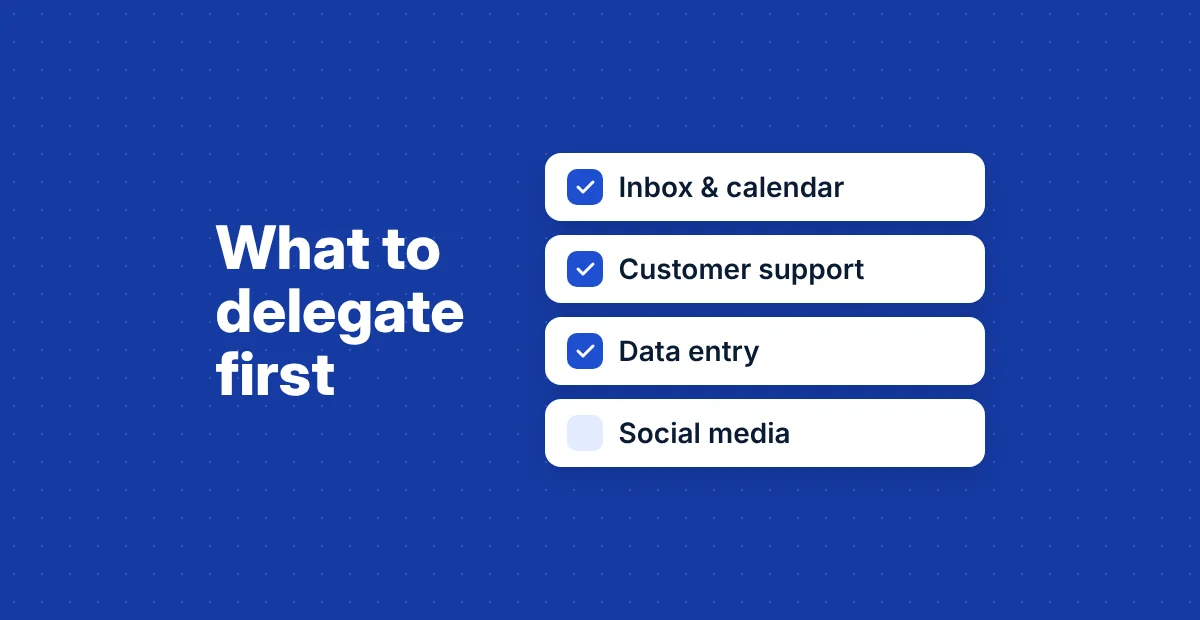
Many owners find that they need fewer hours than they first expect. Our guide on what to delegate first can help you estimate yours.
What changes the price
- Skills. General admin usually costs less than bookkeeping, technical support or marketing work.
- Experience. Upwork lists experience as a key cost factor. Assistants who can work independently and handle more complex tasks generally charge more.
- Location. Rates vary widely by country, often reflecting local living costs.
- Language and communication. Customer-facing work usually needs stronger language skills than behind-the-scenes tasks.
- Availability. Working in your time zone, covering evenings or being on call can cost more.
- Hiring model. Agencies add a margin, but they may include matching, supervision and replacement cover.
- Commitment. Longer or full-time arrangements often work out cheaper per hour than a small number of hours.
Hourly, monthly or full-time: which pricing works best?
| Pricing model | Best for | Watch out for |
|---|---|---|
| Hourly | Occasional or changing work. | Costs that creep up without a monthly cap. |
| Monthly hours | Regular, predictable tasks. | Whether unused hours roll over, and what extra hours cost. |
| Full-time or dedicated | Enough steady work to fill the week. | Paying for idle time if the workload drops. |
| Per project | One-off work, such as a data cleanup. | A clear scope, so the price does not change midway. |
Start small if you can
If you are unsure, begin with a small number of hours for a month or two. Real usage will give you a better estimate than guesswork.
Virtual assistant vs in-house cost
The Bureau of Labor Statistics reports median pay of $48,310 a year for US secretaries and administrative assistants. Benefits add to that. Across private industry, benefits make up about 30 percent of employer compensation costs.
Applying that share as a rough guide, a $48,310 salary works out to about $69,000 a year. That is an estimate, not a role-specific figure, and it does not include recruiting, equipment or office space.
| Option | Hours per year | Estimated yearly cost |
|---|---|---|
| In-house employee, with estimated benefits | Full-time | About $69,000 |
| Full-time VA at $25/hour | 2,080 | $52,000 |
| Full-time VA at $15/hour | 2,080 | $31,200 |
| Part-time VA at $25/hour, 80 hours per month | 960 | $24,000 |
The biggest saving is often the last row. Many small businesses do not have 40 hours of admin work each week, so they can pay for only what they use. Cost should not be the only factor, though. Our virtual assistant vs in-house comparison covers control, availability and management.
How to work out your own budget
- List your tasks. Track what you did for a week and mark what someone else could handle.
- Estimate hours. Add up the weekly time for those tasks and multiply by four.
- Choose the skill level. Decide whether you need general support or a specialist.
- Pick a hiring route. Weigh the lower price of a freelancer against the extra work of managing one.
- Add 10 to 20 percent. Leave room for setup time and unexpected tasks.
- Compare it with the value. Work out what those hours are worth if you spend them on sales or client work.
Some tasks may not need a person at all. Before hiring, check whether simple business automation can handle repetitive work, leaving your assistant with the tasks that need judgment.
Questions to ask before you sign
- Is the price per hour worked, or a fixed monthly fee?
- What happens to unused hours?
- Who covers holidays, sick days or a resignation?
- Is there a contract or minimum term?
- How is access to your accounts and customer data secured?
- Who owns the work and the processes created?
- Are there setup fees or extra charges for software?
Be careful with a price that looks far below the market. It can mean high turnover, limited experience or an assistant shared across too many clients. Ask how the rate is possible before you commit.
Next steps
Start with a one-week task list. Once you know your hours and the skills you need, the hiring route and budget usually become clear.
Would you like help working it out? DigiDesk pricing depends on the number of assistants, hours and skills you need, so we quote based on the work itself. See our virtual assistant services, read about virtual assistant teams or book a free 15-minute strategy call.
Frequently asked questions
How much does a virtual assistant cost per hour?
On Upwork, median virtual assistant rates are $10 to $20 per hour, and Upwork says freelancers charge an average of $18 to $35 per hour depending on skills and experience. Specialized work usually costs more, and rates vary by region.
How much does a virtual assistant cost per month?
Multiply your hours by the hourly rate. At $15 to $35 per hour, 40 hours a month costs about $600 to $1,400, and 160 hours costs about $2,400 to $5,600. These are examples, not fixed prices.
Is a virtual assistant cheaper than hiring an employee?
Usually, yes, for the same hours, because you normally avoid benefits, equipment and office costs. The bigger saving often comes from paying only for the hours you need. A full-time employee can still be the better choice for work that needs constant availability or close supervision.
Why do some virtual assistants charge so much more than others?
Rates reflect experience, specialist skills, location, language ability, availability and whether a company handles hiring, training and backup cover for you.
Should I hire a freelancer or use a managed service?
A freelancer usually suits you if you have time to screen, train and manage someone. A managed service suits you if you would rather pay for matching, support and replacement cover.
Sources
- Virtual assistant hourly rates, Upwork
- Pricing, Magic
- How much do virtual assistants charge in the US?, Wing Assistant
- Secretaries and administrative assistants, US Bureau of Labor Statistics (May 2025 pay data)
- Employer costs for employee compensation, US Bureau of Labor Statistics (June 2026 data)