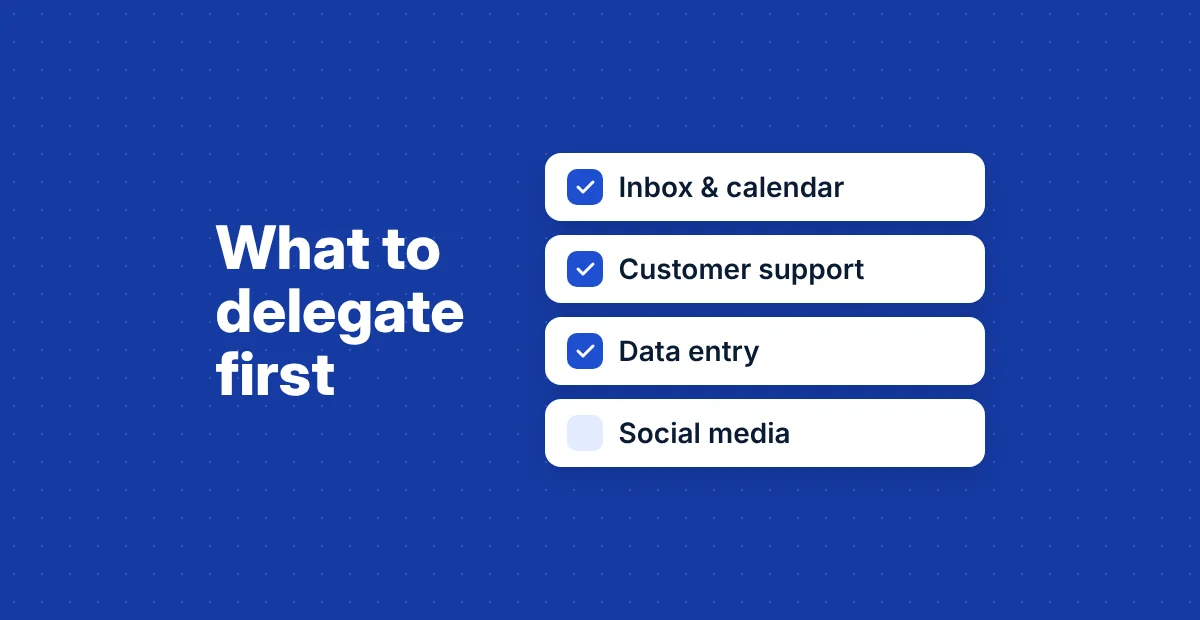
The best first virtual assistant tasks are repeatable, teachable and easy to review. Delegation works when the owner transfers an outcome, context, access and decision rules—not when they send scattered instructions and hope the assistant can infer the process.
Choose repeatable work first
Look for tasks that occur daily or weekly, follow recognizable rules and consume attention without requiring the owner’s unique judgment. Repetition makes training and improvement easier. For owners hiring or onboarding their first virtual assistant, this decision should connect directly to a manageable first delegation backlog with clear standards and secure access. That keeps the discussion grounded in business value instead of surface-level features or assumptions.
Inbox and calendar support
A virtual assistant can categorize messages, draft routine replies, protect focus time and coordinate meetings when priorities and escalation rules are explicit. For owners hiring or onboarding their first virtual assistant, this decision should connect directly to a manageable first delegation backlog with clear standards and secure access. That keeps the discussion grounded in business value instead of surface-level features or assumptions.
Lead and CRM administration
Data entry, enrichment, duplicate cleanup, status updates and follow-up task creation are strong candidates when required fields and quality checks are documented. For owners hiring or onboarding their first virtual assistant, this decision should connect directly to a manageable first delegation backlog with clear standards and secure access. That keeps the discussion grounded in business value instead of surface-level features or assumptions.
Customer support administration
An assistant can answer approved questions, classify tickets, process standard requests and escalate sensitive issues using templates and service-level rules. For owners hiring or onboarding their first virtual assistant, this decision should connect directly to a manageable first delegation backlog with clear standards and secure access. That keeps the discussion grounded in business value instead of surface-level features or assumptions.
Content and marketing operations
Scheduling approved posts, formatting content, gathering assets, updating listings and preparing reports can be delegated without handing over final strategy. For owners hiring or onboarding their first virtual assistant, this decision should connect directly to a manageable first delegation backlog with clear standards and secure access. That keeps the discussion grounded in business value instead of surface-level features or assumptions.
Research and data organization
Define the question, acceptable sources, output format and stopping rule. Good research delegation produces a decision-ready summary rather than a pile of links. For owners hiring or onboarding their first virtual assistant, this decision should connect directly to a manageable first delegation backlog with clear standards and secure access. That keeps the discussion grounded in business value instead of surface-level features or assumptions.
Document the process
Record the goal, trigger, inputs, steps, examples, exceptions, quality standard and owner. A short screen recording helps, but written checkpoints make the process searchable. For owners hiring or onboarding their first virtual assistant, this decision should connect directly to a manageable first delegation backlog with clear standards and secure access. That keeps the discussion grounded in business value instead of surface-level features or assumptions.
Protect access and review quality
Use individual accounts, password management, least privilege and prompt access removal. Review early work closely, then reduce oversight as accuracy becomes consistent. For owners hiring or onboarding their first virtual assistant, this decision should connect directly to a manageable first delegation backlog with clear standards and secure access. That keeps the discussion grounded in business value instead of surface-level features or assumptions.
Build a 30-day implementation plan
Turn the guide into action by choosing one owner, one baseline metric and one outcome for the next 30 days. During week one, document the current state and remove obvious errors. During week two, implement the smallest high-value improvement. During week three, observe real use and collect questions. During week four, compare the new result with the baseline and decide what to standardize, revise or stop.
Keep the plan intentionally narrow. Teams make more progress when they complete one measurable cycle than when they open ten initiatives at once. Store decisions, credentials, content and process notes in systems the team controls. When outside specialists are involved, confirm ownership, access and handoff requirements before work begins.
If you want help translating this plan into a working system, explore DigiDesk’s virtual assistance services or book a strategy call.
Frequently asked questions
What should I delegate first?
Start with a recurring task that takes time, follows clear rules and can be checked quickly.
What should not be delegated immediately?
Delay sensitive decisions, high-risk financial actions and undocumented work that depends on context only the owner has.
How many tasks should a new VA receive?
Begin with a small group of related tasks, stabilize quality and then expand gradually.
How do I measure success?
Use accuracy, turnaround time, completed volume, escalations and the business outcome the task supports.
Next steps
A manageable first delegation backlog with clear standards and secure access starts with a clear baseline and a focused first improvement. Review the checklist, select the action closest to revenue or customer experience and assign it to one owner. Measure what changes, document what the team learns and use that evidence to decide the next investment.